Showing posts with label Interest Rate. Show all posts

Monday

The Death of the Zero Lower Bound: Negative Nominal Interest Rates

The Death of the Zero Lower Bound: Negative Nominal Interest Rates


It is believed that Mario Draghi will cut the ECB’s deposit rate even lower, and will increase the Eurozone’s Quantitative Easing programme, in order to increase aggregate demand in the Eurozone. Meanwhile, the Fed is set to increase interest rates. It seems that the two largest economies are pursuing diverging policies. However, of particular interest is that Draghi seems to have broken the zero lower bound ‘rule’.

Mark Carney Raising Interest Rates: “Oh no he isn’t” “Oh yes he is”

Mark Carney Raising Interest Rates: “Oh no he isn’t” “Oh yes he is”


As pantomime season approaches, and with Christmas round the corner, inflation should increase as Santa fervently embarks on his annual shopping spree for the children of Britain. However, in both September and October inflation was -0.1pc, and on closer inspection it is hard to imagine that it would increase substantially before Christmas. Thus, it seems that the Bank of England will not raise rates this year.

December 2015: the month the Federal Reserve raises interest rates?

December 2015: the month the Federal Reserve raises interest rates?


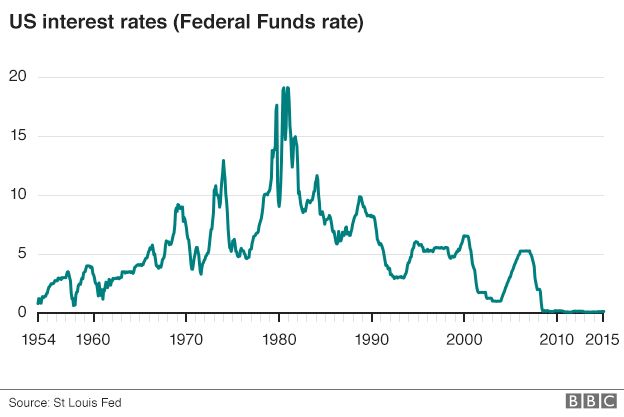
Many feel that the Federal Reserve will raise rates this December, resulting in the first rise since 2006. Indeed, Federal Reserve Chairwoman Janet Yellen stated that a rise in interest rates was a “live possibility”.


Quantitative Easing

Quantitative Easing


Loosening monetary policy could be said to help countries move out of a recession. Usually, the Central Bank would lower interest rates in order to stimulate consumer spending, as consumers would then have a greater incentive to borrow more money, and a disincentive to save their money. However, when nominal interest rates are almost at 0, and domestic demand fails to increase, unconventional measures may need to be used, in order to pull the economy out of the liquidity trap. In the wake of the recent Financial Crisis, the Bank of England’s unconventional weapon of choice was Quantitative Easing. This was instigated in order to increase liquidity and reduce long term interest rates, and so stimulate consumer spending because, as Mervyn King stated at the time, interest rates and fiscal stimulus did not increase consumer demand. Indeed, monetary policy would be much easier and quicker to implement than a fiscal stimulus. Did Quantitative Easing help the Bank meet its 2pc inflation target? Did it help reduce the impact of the financial crisis?